EU CPNP Cosmetics Export: The Ultimate Registration Guide
Exporting cosmetics to Europe? Discover how Skindermlab guarantees EU CPNP cosmetics export registration and compiles your Product Information File (PIF).
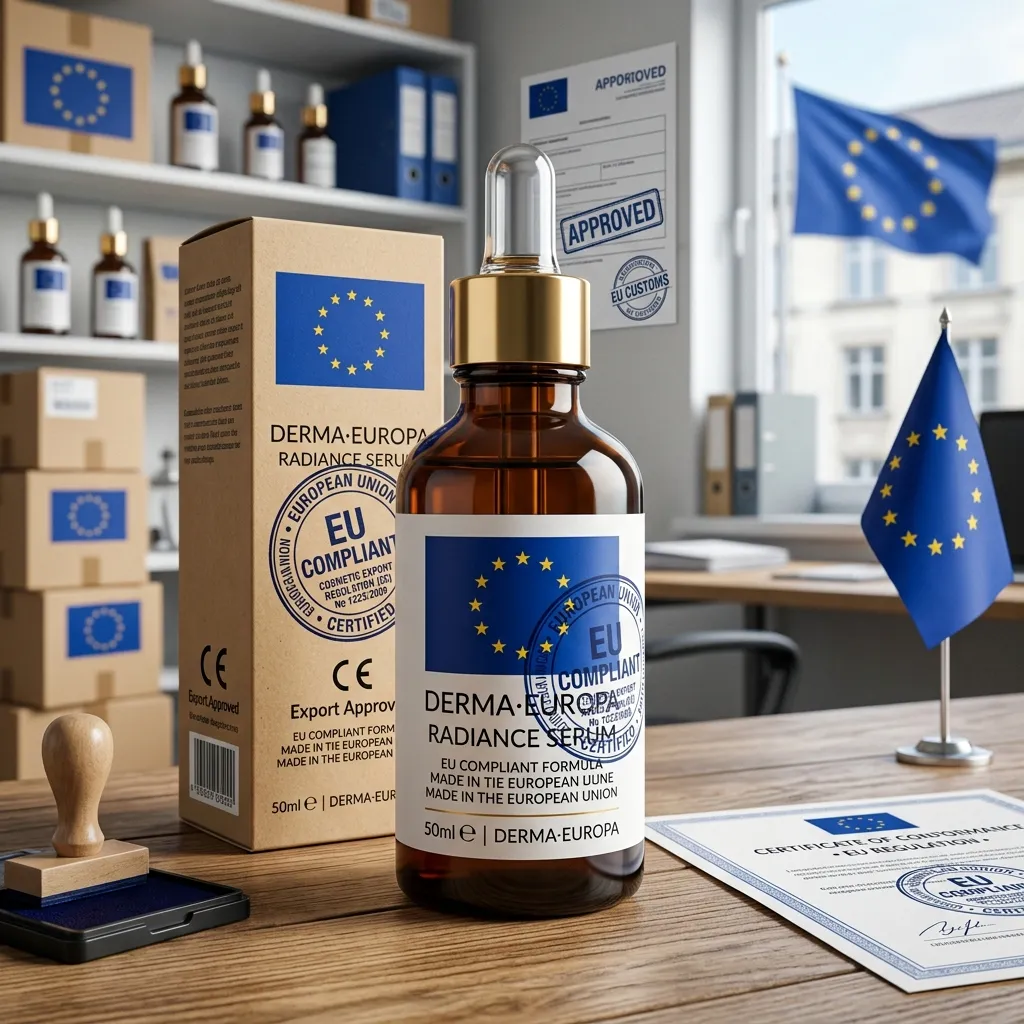
Scaling your private label cosmetic brand beyond domestic borders is the ultimate milestone for B2B growth. The European Union remains one of the largest, most lucrative, and most strictly regulated aesthetic markets in the world.
If you can successfully sell your clinical products in the EU, you instantly elevate your brand’s global prestige.
However, entering the European market is not as simple as shipping a box of serums to Paris. It requires passing through a highly strict, non-negotiable regulatory gateway: EU CPNP cosmetics export registration. If you are a brand owner or clinic planning to export your clinical formulations to Europe, here is the definitive guide on navigating the Cosmetic Products Notification Portal (CPNP) without losing your mind—or your money.
This is where Skindermlab’s GMP manufacturing becomes your greatest asset. We engineer products from day one to be 100% export-ready.
What Exactly Is the CPNP?
The CPNP (Cosmetic Products Notification Portal) is a centralized, digital European regulatory system. Under the strict EU Cosmetics Regulation (EC No 1223/2009), every single cosmetic and medical aesthetic product placed on the EU market must be formally notified through this portal.
Let’s be extremely clear: Attempting to export, distribute, or retail a cosmetic product in any EU member state without CPNP registration is highly illegal. It will result in immediate customs seizure, massive fines, and the permanent destruction of your inventory.
Core Documents Required for EU CPNP Cosmetics Export
You cannot simply create an account on the CPNP and click “upload.” Before you can even log into the portal, your brand must compile a massive, highly technical scientific dossier known as the Product Information File (PIF).
When you partner with Skindermlab, we provide the technical foundation for this entire file:
- Cosmetic Product Safety Report (CPSR): A rigorous, two-part safety assessment that must be legally signed by a qualified toxicologist or safety assessor recognized within the EU. Skindermlab provides all the stability data required for this report.
- Verified GMP Compliance: Absolute, documented proof that the product was manufactured in a facility adhering to European GMP (ISO 22716) standards. You can view Skindermlab’s active OEM export-ready documentation on our certifications page.
- Exact INCI Formula: The complete qualitative and quantitative ingredient list utilizing official, legally accepted INCI nomenclature, precisely mapped by our biochemists.
- Compliant Labeling & Packaging: Final packaging artwork that adheres to EU legal labeling requirements (including the PAO “Period After Opening” symbol, exact clinical warnings, and mandatory translations).
The Formulation Challenge: The CPNP Registration Process
Step 1: Appointing a Responsible Person (RP)
Every cosmetic brand exporting into Europe from outside the EU is legally required to appoint a “Responsible Person.” This RP (an individual or a specialized regulatory firm residing within the EU) assumes full legal liability for the product’s safety and compliance in the European market.
Step 2: Compiling the PIF and CPSR
Your OEM contract manufacturer must supply you with the technical manufacturing data. Skindermlab excels here. We execute and provide the rigorous accelerated stability tests, microbiological challenge tests (PET), and Material Safety Data Sheets (MSDS). Your appointed EU toxicologist uses our flawless lab data to write and approve the CPSR.
Step 3: Portal Notification
Once the PIF is completely finalized and approved, the appointed Responsible Person digitally uploads the product data to the CPNP. Once the system generates a unique CPNP reference number, the product is legally cleared to cross EU customs and be placed on the retail market.
Turnkey Export Solutions: Don’t let European export bureaucracy stall your global launch. Partner with Skindermlab, the GMP-certified contract manufacturer that provides flawless, export-ready PIF documentation. Contact our OEM experts today.
The Most Lethal CPNP Export Failures
Failing to plan for export during the initial formulation phase is a catastrophic B2B mistake. When you partner with Skindermlab, you avoid these critical errors:
| B2B Export Mistake | The Skindermlab Solution |
|---|---|
| Using a Non-GMP Contract Manufacturer | We are fully ISO 22716 GMP certified, guaranteeing compliance. |
| Formulating with EU-Banned Ingredients | Our biochemists strictly exclude all EU-banned substances from R&D. |
| Failing Stability Testing | We execute mandatory stability/micro tests in-house before release. |
| Failing to Update the CPNP After a Reformulation | We provide immediate, transparent INCI updates if a formula is adjusted. |
Why a GMP-Certified OEM Partner is Non-Negotiable
The absolute foundation of EU CPNP cosmetics export registration is documented proof that your product was manufactured under strict GMP standards.
If you partner with a cheap, non-certified facility to save money on manufacturing, it is literally impossible to procure a valid CPSR report from a European toxicologist. If global export is your ultimate goal, verifying ISO 22716 GMP documentation must be your absolute top priority when choosing your contract manufacturer.
Export-Ready OEM Manufacturing with Skindermlab
At Skindermlab, global export compliance is built into our B2B DNA.
Our state-of-the-art, ISO 22716 GMP-certified manufacturing processes ensure that our OEM clients enter the CPNP process with technical product files that are 100% export-ready. We provide the stability testing, the challenge tests, and the flawless formulation chemistry required to pass European scrutiny on the first try.
To discuss scaling your private label brand into the European market, contact our export compliance team today, or explore our manufacturing standards on our Process page.
Frequently Asked Questions
How long does the EU CPNP cosmetics export registration process take? If the Product Information File (PIF) and safety testing (stability/challenge tests) are fully complete—which Skindermlab provides—the actual CPNP portal notification takes only a few days. However, the bottleneck is waiting for the toxicologist to write the CPSR, which can take 4 to 8 weeks.
Who legally owns the CPNP registration—the brand or Skindermlab? The CPNP registration is legally tied to the Brand Owner and your appointed EU Responsible Person. As a private label brand manufacturing with us, you maintain total control and ownership over your EU registrations.
Do I need to pay to re-register my product every year? No. CPNP registration is not an annual subscription. You only need to log in and update the portal if you fundamentally change the formulation, the primary packaging, or the label claims.
Ready to Manufacture This Formulation Under Your Own Brand?
Develop high-performance, proprietary formulations tailored for your clinic or brand. Partner with Skindermlab for ultra-flexible batch sizes (from boutique clinic runs to high-volume commercial production), ISO 22716 GMP certification, and turnkey export compliance.